
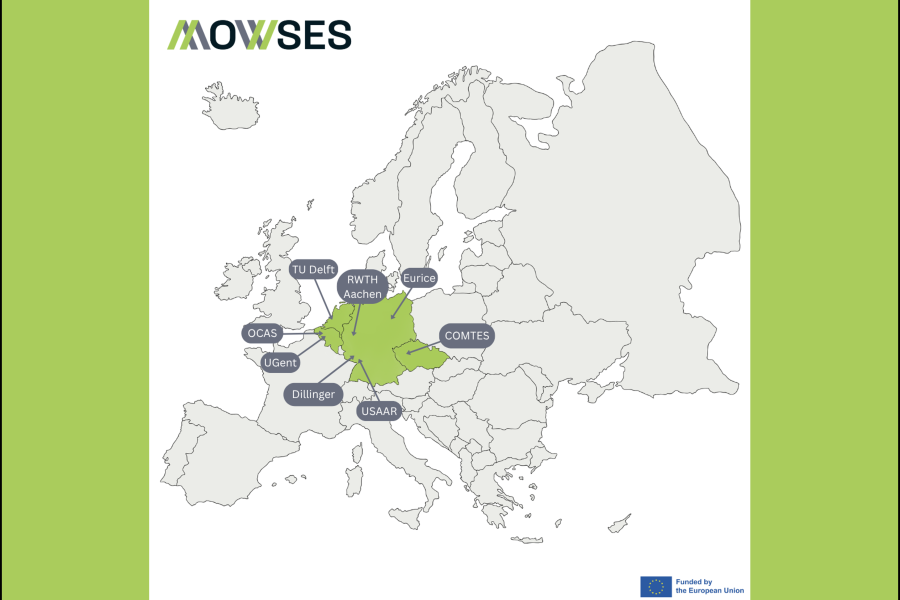
Europe's shift to climate-neutral steelmaking means more recycled scrap, and more residual elements like copper, nickel and molybdenum that can affect weldability and toughness. The EU-funded MOWSES project, coordinated by OCAS, combines production, testing, welding trials and machine learning to define the composition ranges needed for safe, reliable structural steel.
The challenge
Europe’s transition to climate neutrality requires a profound transformation of steel production. Conventional blast furnace routes are highly energy intensive and carbon emitting. In contrast, steel produced via Electric Arc Furnace using recycled scrap can significantly lower CO₂ emissions, potentially by up to 50 percent.
However, increasing the use of scrap introduces so-called residual elements such as copper, nickel and molybdenum. These elements accumulate in recycled steel and cannot easily be removed during production. They may influence mechanical performance, particularly toughness in the heat affected zone of welded joints. Since welded structural steel plates form the backbone of bridges, wind turbines and energy infrastructure, any reduction in weld integrity could compromise safety and long-term reliability.
The MOWSES approach
To address this challenge, a consortium led by OCAS was set-up to systematically investigate how individual residual elements and their combinations influence the strength, toughness and weldability of structural steels. The consortium obtained a grant from the European Commission for the project with the acronym MOWSES (Home | MOWSES).
At the core of the work lies a carefully designed test matrix defining specific steel compositions with controlled variations in residual content. These steels are produced in experimental batches and subjected to realistic welding thermal cycles to replicate industrial conditions.
Advanced microstructural characterisation, mechanical testing and thermomechanical simulations are combined with machine learning tools to analyse the resulting data. This integrated approach enables the consortium to identify critical element thresholds, understand fracture mechanisms in welded zones and propose mitigation strategies.
Impact
The main outcome of MOWSES will be the definition of acceptable chemical composition ranges for weldable green structural steels. These guidelines will support steel producers, fabricators and end users in safely increasing scrap utilisation while maintaining structural integrity.
The project is particularly relevant for European sustainable infrastructure and energy applications, where large, welded steel plates are essential for wind turbines, offshore structures and other critical assets.
By enabling broader acceptance of green structural steels, MOWSES could contribute to an estimated reduction of up to 11.9 million tonnes of CO₂ emissions per year. At the same time, it will strengthen confidence in the safety and durability of infrastructure built with higher scrap content steels.
A Strong First Project Year
In its first year, MOWSES established the technical foundation for all subsequent investigations. A key milestone was the definition of the project’s test matrix, starting with the selection of representative reference steel grades.
The consortium agreed on three widely used European structural plate grades to cover a broad strength range and different delivery conditions:
- S355N (normalised)
- S550M (thermomechanically rolled)
- S690QT (quenched and tempered)
Together, these grades reflect steels commonly applied in critical infrastructure such as bridges, offshore structures and energy installations. Their chemical compositions and delivery conditions were selected to ensure industrial relevance while enabling a systematic and scientifically robust comparison.
Based on these reference grades, the consortium designed a structured test matrix in which selected residual elements are introduced in controlled concentrations, both individually and in defined combinations. This framework enables a direct assessment of how residual content influences microstructure evolution, weldability and fracture behaviour across different strength levels and processing routes.
In parallel, thermodynamic simulations and preparatory experimental activities were initiated, ensuring close alignment between modelling and laboratory work from the outset. The strong cooperation between industrial and academic partners during this first year has created a solid and methodologically sound basis for the detailed investigations that follow.
The path forward
Once the testing batches have been delivered to all project partners, MOWSES will deepen its experimental and modelling activities, expand welding trials and refine predictive tools for fracture behaviour in welded green steels. Results will be translated into practical recommendations for industry and standardisation bodies.
By combining metallurgical expertise, advanced simulations and data driven analysis, MOWSES supports Europe’s ambition to lead in sustainable steel production, ensuring that greener steels remain safe, reliable and ready for the infrastructure of tomorrow.
Project Partners
OCAS – Onderzoekscentrum voor Aanwending van Staal NV
EURICE – European Research and Project Office GmbH
RWTH Aachen – Rheinisch-Westfälische Technische Hochschule Aachen – Welding and Joining Institute
Dillinger – Aktien-Gesellschaft der Dillinger Hüttenwerke
USAAR – Universität des Saarlandes
TU Delft – Technical University of Delft
Project Coordinator
OCAS NV (OnderzoeksCentrum voor de Aanwending van Staal)
Contact: Philippe Thibaux
Funded by the European Union. Views and opinions expressed are however those of the author(s) only and do not necessarily reflect those of the European Union. Neither the European Union nor the granting authority can be held responsible for them.
